
 Deutsch
 Nederlands
 Polski
 Italiano
 Français
 Español
 Română

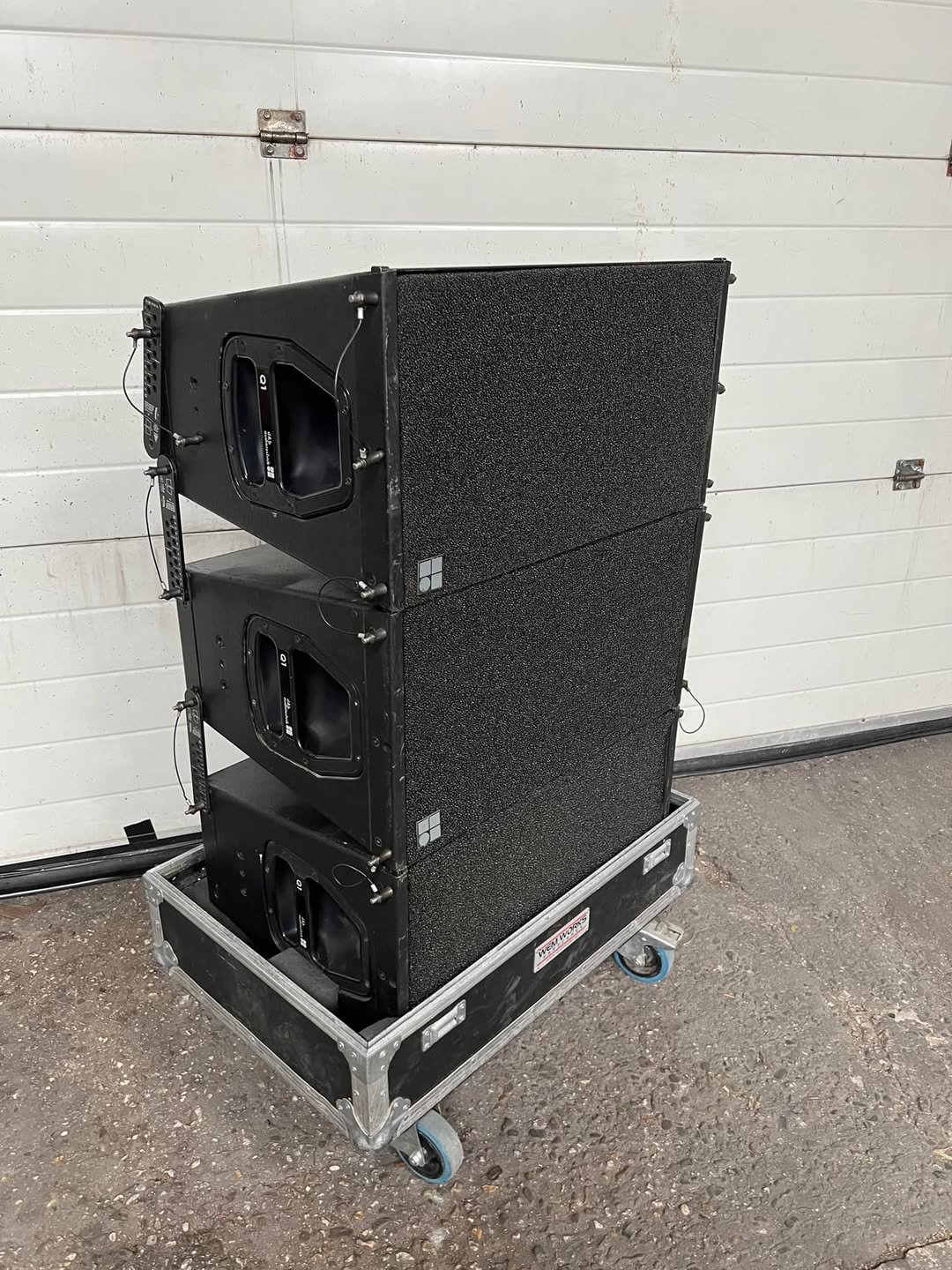
Buy d&b audiotechnik Q1 – Professional Passive Line Array Loudspeaker
The d&b audiotechnik Q1 is a professional two-way passive line array loudspeaker designed for concert touring, live music venues, festivals, theatres, houses of worship, and permanent sound reinforcement installations.
Developed as part of the established d&b audiotechnik Q-Series, the Q1 combines two 10-inch dipole low-frequency drivers with a 1.3-inch high-frequency compression driver and a dedicated toroidal waveguide.
This acoustic arrangement provides controlled horizontal coverage, flexible vertical array shaping, and substantial output from a compact enclosure.
Unlike conventional point-source loudspeakers, the Q1 is specifically engineered to operate in vertical arrays. Multiple cabinets can be connected mechanically and configured with different splay angles to achieve the required audience coverage.
For professional rental companies, touring engineers, system integrators, and venue operators searching for used d&b Q1 line array speakers, this model remains particularly relevant when maintaining or expanding an existing Q-Series system.
Electronic Space provides a point of enquiry for d&b Q1 loudspeakers and professional sound equipment for buyers across Germany, France, the Netherlands, Belgium, Austria, Italy, Spain, Switzerland, and other European markets.
Why the d&b Q1 Remains Relevant for Professional Sound
The Q1 is an established professional line array element designed around controlled directivity and modular system deployment.
Its acoustic architecture allows engineers to combine multiple cabinets into a vertical array while maintaining a consistent nominal horizontal coverage pattern.
Key Advantages
- Professional two-way passive line array design
- Two 10-inch dipole low-frequency drivers
- 1.3-inch high-frequency compression driver
- Toroidal waveguide for controlled HF radiation
- Nominal 75° horizontal dispersion
- Approximately 15° vertical coverage per cabinet at high frequencies
- Adjustable inter-cabinet splay angles
- Frequency response extending to approximately 60 Hz
- Maximum SPL up to approximately 139 dB, amplifier-dependent
- Dedicated d&b amplifier processing
- Integrated professional array rigging provisions
- Compatibility with suitable Q-Series subwoofer systems
The Q1 is especially attractive to operators who already own compatible Q-Series loudspeakers, amplifiers, and rigging hardware.
d&b audiotechnik Q1 Technical Specifications
| Specification | Details |
|---|---|
| Manufacturer | d&b audiotechnik |
| Model | Q1 |
| Product category | Passive line array loudspeaker |
| Acoustic configuration | Two-way |
| Low-frequency drivers | 2 × 10-inch |
| LF arrangement | Dipolar |
| High-frequency driver | 1 × 1.3-inch compression driver |
| HF waveguide | Toroidal |
| Nominal horizontal dispersion | 75° |
| Nominal vertical HF dispersion | 15° per cabinet |
| Inter-cabinet splay | Approximately 0°–14° |
| Standard frequency response | 60 Hz–17 kHz (-5 dB) |
| CUT mode frequency response | 100 Hz–17 kHz (-5 dB) |
| Maximum SPL | Approximately 135–139 dB, amplifier-dependent |
| Power handling | 400 W RMS / 1,600 W peak (10 ms), as supplied |
| Nominal impedance | 8 Ω |
| Standard connectors | 2 × NL4, parallel-wired |
| Optional connector configuration | EP5 |
| Enclosure material | Marine plywood |
| Finish | Impact-resistant protective paint |
| Grille | Metal with acoustically transparent foam |
| Rigging | Integrated front and rear array connections |
| Dimensions (H × W × D) | Approximately 308 × 580 × 410 mm |
| Weight | Approximately 22 kg |
| Amplification | Compatible external d&b amplifier |
The figures above are based on the supplied product information. Confirm the exact cabinet version, amplifier compatibility, rigging limits, and performance ratings against the relevant d&b audiotechnik documentation.
Dual 10-Inch Dipole Low-Frequency Design
The Q1 uses two 10-inch low-frequency drivers arranged in a dipolar configuration.
This is an important part of the loudspeaker’s acoustic design.
Controlled Horizontal Dispersion
The supplied specifications identify nominal horizontal coverage of 75°, with directional control extending down to approximately 400 Hz.
This helps the Q1 maintain a more consistent radiation pattern through a substantial portion of its operating range.
Why Dipole Design Matters
In conventional loudspeakers, horizontal directivity can change significantly as frequency decreases.
The Q1’s dipolar LF arrangement is intended to help manage this transition.
For sound engineers, controlled dispersion can support more predictable system coverage and reduce unnecessary acoustic energy outside the intended audience area.
Benefits in Reflective Venues
In theatres, arenas, and indoor concert spaces, sound reflecting from walls and ceilings can affect clarity.
A loudspeaker with controlled directivity can help engineers manage these interactions through appropriate placement and array design.
Professional Music Reinforcement
The dual-driver arrangement supports the Q1’s intended role in demanding live sound applications.
However, its performance depends on correct amplifier processing, array configuration, and operating conditions.
Toroidal Waveguide and High-Frequency Performance
The Q1 incorporates a 1.3-inch high-frequency compression driver coupled to a toroidal waveguide.
The waveguide is designed to provide the intended high-frequency coverage and support integration between adjacent cabinets in a vertical array.
Consistent Horizontal Coverage
The nominal 75° horizontal dispersion helps engineers plan coverage across the audience area.
Vertical Array Integration
The high-frequency waveguide is designed for operation within a multi-cabinet array.
Speech Intelligibility
High-frequency reproduction contributes to the clarity of vocals, speech, and other programme material.
Musical Detail
The HF section reproduces the upper-frequency content of instruments and recorded music.
Array Performance
The waveguide and cabinet geometry are intended to work together when multiple Q1 elements are deployed.
Correct array design remains essential for achieving the intended performance.
Understanding Q1 Line Array Coverage
The Q1 is not intended to behave like an ordinary standalone point-source loudspeaker.
Its principal application is vertical array deployment.
Multiple Q1 cabinets can be mechanically connected and angled relative to one another.
Horizontal Coverage
Each Q1 has a nominal horizontal coverage angle of 75°.
This characteristic influences the width of the listening area addressed by the array.
Vertical Coverage
The supplied specifications identify approximately 15° vertical high-frequency coverage per cabinet.
Adjustable Splay Angles
Inter-cabinet splay angles can be adjusted within the supported range of approximately 0°–14°.
This allows engineers to create different vertical array profiles.
Smaller Splay Angles
Smaller angles may be useful in sections of an array intended to address more distant audience areas.
Larger Splay Angles
Larger angles may be useful where the array must cover closer audience positions.
Array Curvature
By combining different angles, engineers can develop an array profile suited to the venue geometry.
The correct angles should be determined through manufacturer-supported prediction and rigging procedures.
d&b Q1 Frequency Response and Acoustic Modes
The supplied specifications identify two primary frequency response configurations.
| Operating mode | Frequency response |
|---|---|
| Standard | Approximately 60 Hz–17 kHz (-5 dB) |
| CUT | Approximately 100 Hz–17 kHz (-5 dB) |
Standard Mode
Standard operation provides the Q1’s intended full-range frequency response.
This may be suitable for selected applications where the system does not require extensive low-frequency reinforcement.
CUT Mode
CUT mode reduces low-frequency output when the Q1 operates with suitable subwoofers.
This allows the subwoofer system to handle lower bass frequencies while the Q1 reproduces the remaining programme material.
Why CUT Mode Is Important
In larger touring systems, dedicated subwoofers frequently reproduce the lowest frequencies.
Reducing unnecessary low-frequency demand on the main array can support more efficient system operation.
The correct operating mode depends on the complete loudspeaker configuration.
HFC and CPL Processing for Q1 Arrays
The supplied information identifies two additional processing functions: HFC and CPL.
These are particularly relevant to multi-cabinet line array systems.
HFC – High-Frequency Compensation
High-frequency sound is affected by air absorption, particularly over longer propagation distances.
HFC processing is designed to compensate for this effect in appropriate long-throw applications.
This can help engineers manage tonal balance between audience areas at different distances.
CPL – Coupling Compensation
When multiple line array cabinets operate together, their acoustic interaction can affect the overall frequency response.
CPL processing provides compensation for relevant coupling effects.
It may be useful when adjusting the tonal balance of different array configurations.
Why Array Processing Matters
The acoustic behaviour of a single cabinet differs from that of a multi-cabinet array.
Correct processing helps the system operate as intended.
HFC and CPL settings should be selected according to the applicable d&b documentation and the actual array design.
Maximum SPL and Amplifier Performance
The supplied specifications identify maximum SPL values that depend on the amplifier used.
| Amplifier platform | Listed maximum SPL |
|---|---|
| d&b D6 | Approximately 135 dB |
| d&b 10D | Approximately 135 dB |
| d&b D12 | Up to approximately 139 dB |
| d&b D20 | Up to approximately 139 dB |
| d&b D80 | Up to approximately 139 dB |
These figures are based on the supplied product information and should be verified for the exact amplifier configuration.
What Maximum SPL Means
Maximum sound pressure level describes output measured under specified test conditions.
It is not the same as the level that every listener will experience during an event.
Real-World Performance
Actual system output depends on:
- Number of Q1 cabinets
- Amplifier configuration
- Array geometry
- Signal content
- System processing
- Audience distance
- Environmental conditions
- Subwoofer integration
For professional touring applications, system prediction and measurement are essential.
Compatible d&b Amplifiers
The Q1 is a passive loudspeaker and requires suitable external amplification.
The supplied information references several d&b amplifier platforms.
Amplifier Compatibility Overview
| Amplifier | Consideration |
|---|---|
| d&b D6 | Referenced Q1 support |
| d&b D12 | Referenced Q1 support |
| d&b D20 | Referenced Q1 support |
| d&b D80 | Referenced Q1 support |
| d&b 10D | Referenced Q1 support |
The exact amplifier configuration, firmware, available presets, and permitted channel loading must be verified.
Dedicated Q1 Processing
Compatible d&b amplifiers provide model-specific loudspeaker processing.
CUT Mode
The appropriate configuration allows operation with suitable subwoofer systems.
HFC and CPL
Supported processing functions help manage array response.
Loudspeaker Protection
Correct amplifier configuration provides the intended loudspeaker protection functions.
Amplifier Channel Loading
The supplied specifications reference typical configurations involving two Q1 cabinets per amplifier channel.
The permitted number depends on the exact amplifier, impedance, and manufacturer operating limits.
d&b Q1 Rigging and Array Deployment
The Q1 includes dedicated rigging provisions for professional vertical array applications.
The supplied information identifies front and rear rigging sockets, locking pins, and splay links.
Integrated Rigging Connections
These provide mechanical connection points between compatible array elements.
Adjustable Cabinet Angles
The rigging system supports the required inter-cabinet splay settings within approved limits.
Flown Arrays
Q1 cabinets can be suspended in suitable configurations using the appropriate manufacturer-approved rigging equipment.
Array Size
The supplied information references flown arrays containing up to 20 Q1 cabinets.
This should not be interpreted as a universal limit for every rigging arrangement.
The permitted cabinet quantity depends on the exact frame, hardware, configuration, and structural loading.
Rigging Safety
Professional line array rigging requires careful planning.
Before flying a Q1 array, verify:
- Manufacturer-approved rigging components
- Mechanical load limits
- Cabinet and hardware condition
- Array geometry
- Suspension points
- Secondary safety requirements
- Applicable local regulations
Never assume that the maximum advertised array size is safe without checking the complete rigging configuration.
Building a d&b Q1 Line Array System
The Q1’s modular design allows multiple cabinets to be combined according to the coverage requirements of the venue.
Small Vertical Arrays
A smaller number of Q1 cabinets may be appropriate for selected compact venues or supplementary reinforcement positions.
Medium Touring Arrays
Larger arrays can be designed to provide greater vertical coverage and output.
Festival Systems
Professional outdoor productions may use multiple Q1 cabinets with suitable subwoofer reinforcement.
Permanent Installations
Fixed arrays can be configured for theatres, auditoriums, houses of worship, and other venues.
Example System Components
| Equipment | Function |
|---|---|
| d&b Q1 cabinets | Main array elements |
| Compatible d&b amplifiers | Amplification and processing |
| Approved Q-Series rigging | Mechanical suspension |
| Compatible subwoofers | Low-frequency reinforcement |
| Signal distribution | Audio routing |
| Speaker cabling | Amplifier-to-loudspeaker connections |
| System prediction and measurement | Coverage planning and alignment |
These components illustrate a typical system architecture and are not necessarily included in the advertised Q1 offer.
Integrating the Q1 with d&b Q-SUB
The Q1 can be used with compatible Q-Series low-frequency systems, including the d&b Q-SUB.
Why Add Q-SUB?
The Q-SUB provides dedicated low-frequency reinforcement beneath suitable Q1 arrays.
This can be valuable for music productions requiring greater bass output.
Concert Touring
Main arrays and subwoofers can be configured to meet the requirements of different venues.
Festival Sound
Multiple subwoofers may be used to provide suitable low-frequency coverage.
Indoor Venues
Subwoofer placement and processing can help manage bass distribution.
System Alignment
Correct integration requires appropriate amplifier processing, crossover configuration, and delay alignment.
The exact system configuration should follow the relevant d&b documentation.
NL4 and EP5 Connector Configurations
The supplied information identifies standard dual NL4 connectors wired in parallel.
It also references optional EP5 connector versions.
NL4 Connections
NL4 connectors are commonly used for professional passive loudspeaker systems.
Parallel Wiring
The supplied information identifies parallel wiring between the standard connectors.
EP5 Variants
Some Q1 cabinets may be fitted with EP5 connectors.
SenseDrive
The supplied specifications associate optional EP5 configurations with SenseDrive compatibility.
Actual SenseDrive support depends on the loudspeaker wiring, amplifier, and system configuration.
Buying Considerations
When purchasing used Q1 cabinets, verify that the connector type matches the existing inventory.
Different connector configurations can affect cable requirements and system integration.
Q1 Cabinet Construction and Touring Durability
The Q1 uses a marine plywood enclosure with an impact-resistant protective finish.
Professional Plywood Construction
The enclosure provides a rigid structure for the loudspeaker’s drivers and rigging components.
Protective Grille
A metal grille protects the front of the cabinet.
Acoustic Foam
The grille is backed with acoustically transparent foam.
Integrated Side Handles
Handles support professional handling and positioning.
Touring Use
The cabinet is relevant to rental companies operating transportable line array systems.
Permanent Installations
The Q1 can also be considered for suitable fixed installations.
For used equipment, the condition of the cabinet and rigging components is particularly important.
Dimensions and Weight
| Measurement | Approximate value |
|---|---|
| Height | 308 mm |
| Width | 580 mm |
| Depth | 410 mm |
| Weight | 22 kg |
The compact cabinet height allows multiple Q1 elements to be arranged vertically.
Transport Planning
The weight of each cabinet contributes to the total weight of the array and transport package.
Rigging Calculations
All cabinets, frames, links, and other suspended components must be included in mechanical calculations.
Storage
Suitable transport cases and storage conditions can help protect the equipment.
Venue Access
Cabinet dimensions should be considered when planning loading, unloading, and installation.
Professional Applications for the d&b Q1
Concert Touring
The Q1 is designed for vertical array applications and can be considered for professional touring systems.
Live Music Festivals
Multiple cabinets can be deployed to provide suitable coverage in appropriately designed festival systems.
Theatres
Controlled dispersion and flexible array shaping can be useful in theatre sound reinforcement.
Houses of Worship
Q1 arrays may be suitable for worship spaces requiring controlled audience coverage.
Corporate Events
The system can be considered for larger corporate productions requiring professional speech and music reinforcement.
Permanent Installations
Fixed arrays can be designed for auditoriums and entertainment venues.
Rental Company Inventories
Companies operating Q-Series systems may purchase additional Q1 cabinets to maintain or expand their inventory.
Why Used d&b Q1 Cabinets Remain Attractive
The Q1 is an established professional loudspeaker model.
For buyers who already own compatible Q-Series equipment, additional cabinets may offer practical advantages.
Inventory Expansion
Additional Q1 cabinets can support larger array configurations.
Replacement Equipment
Matching cabinets may be useful when replacing damaged or retired units.
Existing Amplifier Compatibility
Operators with suitable d&b amplifiers may be able to integrate additional Q1 cabinets without changing the complete amplification platform.
Rigging Standardisation
Compatible rigging hardware can simplify deployment within an established system.
Familiar System Workflow
Engineers experienced with Q-Series equipment may benefit from maintaining a consistent loudspeaker platform.
However, the age and condition of used equipment, spare-part availability, and ongoing manufacturer support should be considered.
Buying a Used d&b Q1 – Inspection Checklist
Professional buyers should carefully inspect both the acoustic and mechanical condition of Q1 cabinets.
1. Verify the Low-Frequency Drivers
Confirm that both 10-inch drivers operate correctly.
2. Test the High-Frequency Driver
Check for distortion, abnormal output, or previous repairs.
3. Inspect the Waveguide
Examine the high-frequency assembly for damage.
4. Check the Enclosure
Look for cracks, moisture exposure, and structural wear.
5. Inspect the Rigging Sockets
Verify that all rigging connections are undamaged.
6. Check Locking Pins and Splay Links
Confirm that the required mechanical components are present and suitable for use.
7. Verify Connector Type
Determine whether the cabinets use NL4 or EP5 connectors.
8. Confirm Amplifier Compatibility
Check that the intended amplifier supports the required Q1 configuration.
9. Request Serial Numbers
Serial numbers can help identify the equipment and relevant documentation.
10. Review Service History
Ask whether drivers, connectors, or rigging components have been replaced.
11. Confirm Quantity
Determine the exact number of cabinets included in the offer.
12. Check Included Accessories
Ask whether flying frames, rigging pins, links, cables, or transport cases are included.
13. Request Functional Testing
Where possible, arrange testing using appropriate amplification.
14. Confirm Price and Condition
The supplied information does not specify the selling price, available quantity, or current equipment condition.
Contact Electronic Space for these details.
d&b Q1 vs Conventional Point-Source Loudspeakers
| Feature | d&b Q1 | Conventional point-source loudspeaker |
|---|---|---|
| Acoustic design | Two-way line array element | Model-dependent |
| LF drivers | Dual 10-inch dipole | Varies |
| HF system | Compression driver with toroidal waveguide | Varies |
| Horizontal coverage | 75° nominal | Model-dependent |
| Vertical coverage | Designed for array integration | Usually fixed by cabinet design |
| Array splay | Adjustable | Usually not applicable |
| Main deployment | Vertical arrays | Individual or clustered cabinets |
| Amplification | External d&b amplifier | Passive or active |
| Rigging | Dedicated array hardware | Model-dependent |
The Q1 is particularly relevant where a modular vertical array is required.
A point-source loudspeaker may be more practical for smaller applications where a full line array is unnecessary.
Frequently Asked Questions About d&b audiotechnik Q1
What is the d&b Q1?
The Q1 is a professional two-way passive line array loudspeaker designed for vertical array deployment.
How many drivers does the Q1 have?
It contains two 10-inch low-frequency drivers and one 1.3-inch high-frequency compression driver.
Is the Q1 a passive loudspeaker?
Yes. It requires compatible external amplification.
What is the horizontal dispersion of the Q1?
The supplied specifications identify 75° nominal horizontal dispersion.
What is the vertical dispersion?
Approximately 15° per cabinet at high frequencies, according to the supplied information.
What splay angles does the Q1 support?
The supplied specifications identify an approximate range of 0°–14°.
What is the frequency response of the Q1?
Approximately 60 Hz–17 kHz in standard mode.
What is CUT mode?
CUT mode reduces low-frequency output for integration with suitable subwoofers.
What does HFC do?
HFC compensates for high-frequency air absorption in appropriate long-throw applications.
What does CPL mean?
CPL is coupling compensation processing used to manage the response of suitable array configurations.
How loud is the d&b Q1?
The supplied specifications list maximum SPL of approximately 135–139 dB, depending on the amplifier.
What is the nominal impedance of the Q1?
8 ohms.
What is the power handling?
The supplied figures are 400 W RMS and 1,600 W peak under short-duration test conditions.
Can the Q1 be used with a d&b D12 amplifier?
The supplied information identifies the D12 as a compatible amplifier platform, subject to the correct configuration.
Can the Q1 be used with a d&b D80?
The supplied information references D80 compatibility. Verify the required Q1 preset and firmware support.
How many Q1 cabinets can be connected to one amplifier channel?
The supplied information references typical arrangements involving two cabinets per channel. Confirm the approved loading for the exact amplifier.
How many Q1 cabinets can be flown together?
The supplied information references arrays of up to 20 cabinets, but the actual permitted quantity depends on the approved rigging configuration.
Can the Q1 be used with Q-SUB?
Yes. It can be integrated with compatible Q-Series subwoofers.
Does the Q1 have built-in amplification?
No. It is a passive loudspeaker.
What connectors does the Q1 use?
The supplied information identifies standard dual NL4 connectors, with optional EP5 configurations.
Does the Q1 support SenseDrive?
The supplied information associates certain EP5 configurations with SenseDrive compatibility, subject to suitable amplifier and cabling requirements.
How much does a Q1 weigh?
Approximately 22 kg.
What are the Q1 dimensions?
Approximately 308 × 580 × 410 mm.
Is the d&b Q1 suitable for permanent installations?
Yes. It can be used in suitable fixed line array systems.
Is the Q1 still worth buying?
It can remain a practical purchase for operators maintaining compatible Q-Series systems, provided its condition and support requirements are satisfactory.
How much does a d&b Q1 cost?
Pricing depends on condition, quantity, and included accessories. Contact Electronic Space for a quotation.
Where can I buy d&b Q1 line array speakers in Europe?
Electronic Space provides a point of enquiry for d&b Q1 loudspeakers and related professional audio equipment.
D&b audiotechnik Q1 for sale in Europe
The d&b audiotechnik Q1 passive line array loudspeaker offers controlled dispersion, modular vertical array deployment, and professional sound reinforcement performance.
Its dual 10-inch dipole drivers, 1.3-inch compression driver, toroidal waveguide, and adjustable rigging geometry make it relevant to touring productions, live music venues, theatres, festivals, and permanent installations.
For professional buyers maintaining existing Q-Series systems, the Q1 may provide a practical way to expand or replace compatible line array inventory.
Before purchasing, confirm the exact cabinet quantity, condition, connector configuration, amplifier compatibility, and included rigging hardware.
For buyers searching for d&b Q1 line array speakers for sale in Germany, France, the Netherlands, Belgium, Austria, Italy, Spain, Switzerland, or elsewhere in Europe, Electronic Space provides a point of enquiry for the equipment.
Contact Electronic Space to request d&b Q1 pricing, confirm current availability, discuss system compatibility, and arrange European or international delivery.
Be the first to review “D&B audiotechnik Q1”
Related products
Power Amps
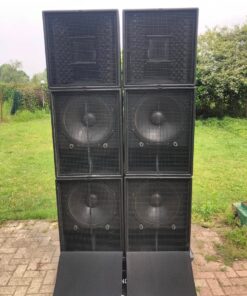
Complete System
Mc2 Audio Amplifiers
Funktion One
Power Amps
Funktion One
Mc2 Audio Amplifiers
Power Amps
Reviews
There are no reviews yet.